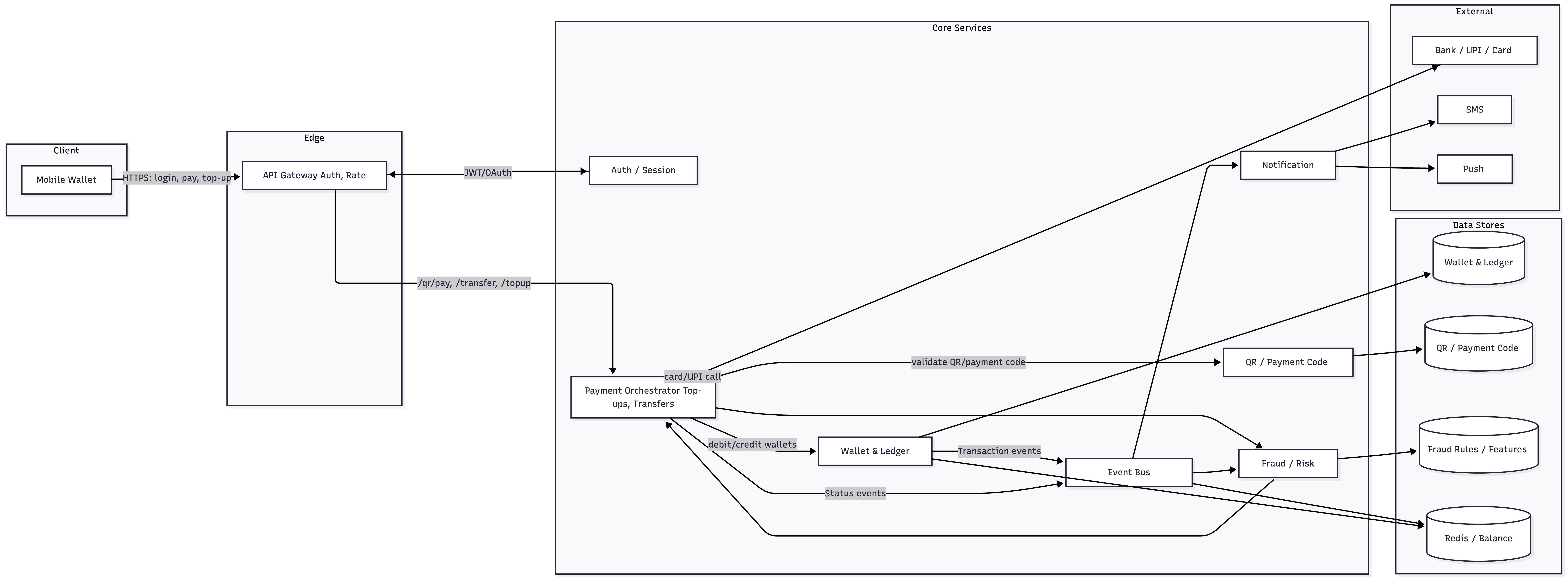
As part of this post, we’ll be covering the design of a mobile wallet payment system that supports -
- Top-ups (add money to wallet from bank/card)
- P2P transfers (wallet -> wallet)
- Basic fraud detection
- Concurrency with clear trade-offs between strong and eventual consistency at scale.
Let’s start with a basic design and then we can scale it up.
1. Single node with relational DB #
CREATE TABLE wallet (
    id            BIGINT PRIMARY KEY,
    owner_id      BIGINT NOT NULL,
    balance_cents BIGINT NOT NULL,
    version       BIGINT NOT NULL DEFAULT 0
);

CREATE TABLE wallet_transaction (
    id               BIGSERIAL PRIMARY KEY,
    from_wallet_id   BIGINT,
    to_wallet_id     BIGINT,
    amount_cents     BIGINT NOT NULL,
    payment_status   VARCHAR(32) NOT NULL,
    created_at       TIMESTAMP NOT NULL DEFAULT now()
);
We use a single DB transaction per operation to ensure atomicity and acquire row locks.
But there are still lots of issues with this basic design:
- Balance is a mutable column: bugs can overwrite it.
- No strong audit guarantees: we can’t easily replay transactions or recover from failures.
This sets the stage for a ledger-based design
2. Ledger-Based Design #
Modern wallets usually move from “balance column” to a ledger-based design with double-entry style accounting.
Ledger Schema #
Instead of directly mutating balance, we only append immutable ledger entries. Balance is then calculated by summing up the entries for a wallet.
CREATE TABLE wallet (
    id       BIGINT PRIMARY KEY,
    owner_id BIGINT NOT NULL
);

CREATE TABLE ledger_entry (
    id               BIGSERIAL PRIMARY KEY,
    wallet_id        BIGINT NOT NULL,
    amount_cents     BIGINT NOT NULL, -- positive for credit, negative for debit
    transaction_id   BIGINT NOT NULL,
    entry_type       VARCHAR(32) NOT NULL, -- e.g. TRANSFER_DEBIT, TRANSFER_CREDIT, TOP_UP
    created_at       TIMESTAMP NOT NULL DEFAULT now()
);

CREATE TABLE transaction (
    id               BIGSERIAL PRIMARY KEY,
    external_id      VARCHAR(64), -- for idempotency or PSP reference
    type             VARCHAR(32) NOT NULL,
    status           VARCHAR(32) NOT NULL,
    from_wallet_id   BIGINT,
    to_wallet_id     BIGINT,
    amount_cents     BIGINT NOT NULL,
    created_at       TIMESTAMP NOT NULL DEFAULT now(),
    UNIQUE (external_id)
);
@Transactional
public TransactionEntity topUp(Long walletId, long amountCents, String externalId) {
TransactionEntity tx = transactionRepository
.findByExternalId(externalId)
.orElseGet(() -> {
TransactionEntity t = new TransactionEntity();
t.setExternalId(externalId);
t.setType("TOP_UP");
t.setFromWalletId(null);
t.setToWalletId(walletId);
t.setAmountCents(amountCents);
t.setStatus("PENDING");
return transactionRepository.save(t);
});
if ("SUCCESS".equals(tx.getStatus())) {
return tx; // idempotent replay
}
LedgerEntryEntity ledger = new LedgerEntryEntity();
ledger.setWalletId(walletId);
ledger.setAmountCents(amountCents);
ledger.setTransactionId(tx.getId());
ledger.setEntryType("TOP_UP_CREDIT");
ledgerRepository.save(ledger);
tx.setStatus("SUCCESS");
return transactionRepository.save(tx);
}Balance Query #
public long getBalance(Long walletId) {
    Long sum = ledgerRepository.sumAmountByWalletId(walletId);
    return sum != null ? sum : 0L;
}
There are still issues with this design:
- Performance: naive summing is expensive, we need to add caches.
- Concurrency control: is needed.
3. Ledger + Materialized Balance #
CREATE TABLE ledger_entry (
    id               BIGSERIAL PRIMARY KEY,
    wallet_id        BIGINT NOT NULL,
    amount_cents     BIGINT NOT NULL,  -- +10000 for credit, -5000 for debit
    tx_id            BIGINT NOT NULL,
    entry_type       VARCHAR(32) NOT NULL,  -- TOPUP_CREDIT, TRANSFER_DEBIT
    created_at       TIMESTAMP DEFAULT now()
);

-- Index for fast wallet scans
CREATE INDEX idx_ledger_wallet_created ON ledger_entry(wallet_id, created_at);
Materialized Balance Table #
For fast reads, maintain a projection updated inside the same transaction as ledger writes.
CREATE TABLE wallet_balance (
    wallet_id              BIGINT PRIMARY KEY,
    available_balance_cents BIGINT NOT NULL DEFAULT 0,
    locked_balance_cents    BIGINT NOT NULL DEFAULT 0,
    updated_at              TIMESTAMP DEFAULT now(),
    version                 BIGINT DEFAULT 0  -- for optimistic locking
);
Double-Entry Extension (for advanced audits) #
For full accounting compliance, extend the ledger to double‑entry:
-- Every txn has debit + credit entries across accounts (user wallet ↔ treasury)
ALTER TABLE ledger_entry ADD COLUMN account_id BIGINT;
ALTER TABLE ledger_entry ADD COLUMN direction VARCHAR(10);  -- DEBIT/CREDIT
To catch drift, run a nightly job that recomputes balances and compares against the materialized table. Alert if there is a mismatch.
4. Concurrency Control for Balances #
What could be the challenges while dealing with concurrency control?
- Double-spend / lost updates: when multiple operations hit the same wallet at the same time (e.g., two transfers spending the same money).
- Duplicate transactions: from retries, flaky networks, payment gateway timeouts.
- High contention: on “hot” wallets (e.g., popular merchants, exchanges).
- Race conditions: across services (e.g., wallet service vs. fraud service vs. notification service).
Let’s try to solve these one by one.
A. Preventing Double-Spend per Wallet #
We should never allow two balance modifying operations on the same wallet to run concurrently, even under high load.
For this, we can use a per-wallet lock so operations on different wallets can proceed concurrently.
For this, we can either implement custom striped locks or simply use Guava’s striped locks.
import java.util.concurrent.ConcurrentHashMap;
import java.util.concurrent.locks.Lock;
import java.util.concurrent.locks.ReentrantLock;

public class BoundedStripedLockManager {

    private final ConcurrentHashMap<Integer, Lock> stripes = new ConcurrentHashMap<>();
    private final int stripesCount;

    public BoundedStripedLockManager(int stripesCount) {
        this.stripesCount = stripesCount; //1024
    }

    //many keys map to the smaller set of locks
    private int stripeKey(long walletId) {
        int h = Long.hashCode(walletId);
        h ^= (h >>> 16);
        int idx = h % stripesCount;
        return idx < 0 ? idx + stripesCount : idx;
    }

    public Lock lockForWallet(long walletId) {
        int key = stripeKey(walletId);
        return stripes.computeIfAbsent(key, k -> new ReentrantLock());
    }
}
Or simply with Guava:
import com.google.common.util.concurrent.Striped;

import java.util.concurrent.locks.Lock;

public class WalletLockManager {

    // 1024 stripes => up to 1024 locks spread across wallet IDs
    private final Striped<Lock> walletLocks = Striped.lock(1024);

    public Lock lockForWallet(long walletId) {
        return walletLocks.get(walletId);
    }
}
public class WalletService {
private final StripedWalletLockManager lockManager;
public WalletService(StripedWalletLockManager lockManager) {
this.lockManager = lockManager;
}
public void transfer(long fromWalletId, long toWalletId, long amountCents) {
// Enforce deterministic lock order to avoid deadlocks
long firstId = Math.min(fromWalletId, toWalletId);
long secondId = Math.max(fromWalletId, toWalletId);
Lock firstLock = lockManager.lockForWallet(firstId);
Lock secondLock = lockManager.lockForWallet(secondId);
firstLock.lock();
try {
secondLock.lock();
try {
doTransfer(fromWalletId, toWalletId, amountCents);
} finally {
secondLock.unlock();
}
} finally {
firstLock.unlock();
}
}
private void doTransfer(long fromWalletId, long toWalletId, long amountCents) {
// DB transaction: check balances, write ledger entries, update projections, etc.
}
}You map multiple wallets to a limited number of locks (striping) so you don’t have to maintain a lock for each wallet id leading to a large number of tiny lock objects in a big wallet system.
B. DB Level Concurrency: Row Locks and Optimistic Retries #
Even with in-memory locks, multiple instances could race on the same wallet database row. You need DB-level concurrency control as well.
a. Pessimistic Locking #
public interface WalletBalanceRepository extends JpaRepository<WalletBalanceEntity, Long> {

    @Lock(LockModeType.PESSIMISTIC_WRITE)
    @Query("select b from WalletBalanceEntity b where b.walletId = :walletId")
    WalletBalanceEntity findByWalletIdForUpdate(@Param("walletId") long walletId);
}
b. Optimistic Locking with Retries #
Under high contention, pessimistic locking can cause long waits and deadlocks. Optimistic locking avoids this by only checking for conflicts at commit time. Attach a version field to wallet_balance. On update, JPA will throw OptimisticLockException if the version has changed since load. Retry the operation with fresh state.
@Entity
@Table(name = "wallet_balance")
public class WalletBalanceEntity {

    @Id
    private Long walletId;

    private Long availableBalanceCents;

    @Version
    private Long version;

    // getters/setters
}
@Service
public class OptimisticWalletService {
private static final int MAX_RETRIES = 5;
@Autowired
private WalletBalanceRepository balanceRepository;
@Autowired
private LedgerRepository ledgerRepository;
public void transfer(long fromWalletId, long toWalletId, long amountCents, long txId) {
for (int attempt = 1; attempt <= MAX_RETRIES; attempt++) {
try {
doTransferOnce(fromWalletId, toWalletId, amountCents, txId);
return;
} catch (ObjectOptimisticLockingFailureException ex) {
if (attempt == MAX_RETRIES) {
throw new ConcurrentModificationException("Too much contention, please retry later", ex);
}
// backoff could be added here
}
}
}
@Transactional
protected void doTransferOnce(long fromWalletId, long toWalletId, long amountCents, long txId) {
WalletBalanceEntity from = balanceRepository.findById(fromWalletId).orElseThrow();
WalletBalanceEntity to = balanceRepository.findById(toWalletId).orElseThrow();
if (from.getAvailableBalanceCents() < amountCents) {
throw new IllegalStateException("Insufficient funds");
}
from.setAvailableBalanceCents(from.getAvailableBalanceCents() - amountCents);
to.setAvailableBalanceCents(to.getAvailableBalanceCents() + amountCents);
balanceRepository.save(from);
balanceRepository.save(to);
ledgerRepository.insertTransferEntries(fromWalletId, toWalletId, amountCents, txId);
}
}C. Idempotency #
The request can contain an idempotency key generated at the client side through a random ID generator, and then its uniqueness can be enforced at the DB level.
ALTER TABLE transaction
ADD COLUMN idempotency_key VARCHAR(64),
ADD CONSTRAINT uk_tx_idempotency UNIQUE (idempotency_key, from_wallet_id);
D. Available vs Locked Balance Under Concurrency #
- Available balance: money that can be spent.
- Locked balance: reserved for in-flight operations.
E. Concurrency in Caches and Projections #
You’ll likely cache wallet balances (Redis, in-memory) and maintain projections for history and analytics. Challenges include:
- 2 threads updating the cache concurrently and overriding each other.
- Cache becoming inconsistent with DB under failure or retries.
Therefore, we should:
- Treat the ledger and balance table as the only source of truth; caches are ephemeral.
- Use atomic operations in the cache (e.g., Redis
INCRguarded by Lua scripts) if you adjust balances in the cache.
F. Fraud Detection and Risk #
Before committing a transaction, apply fast rules. For example:
- Daily transaction amount limits per user tier (KYC‑based).
- Velocity checks: number of transactions in last N minutes.
- Device/IP velocity: too many attempts from same device.
- Risky patterns: new device + large amount.
5. End to End Flow #